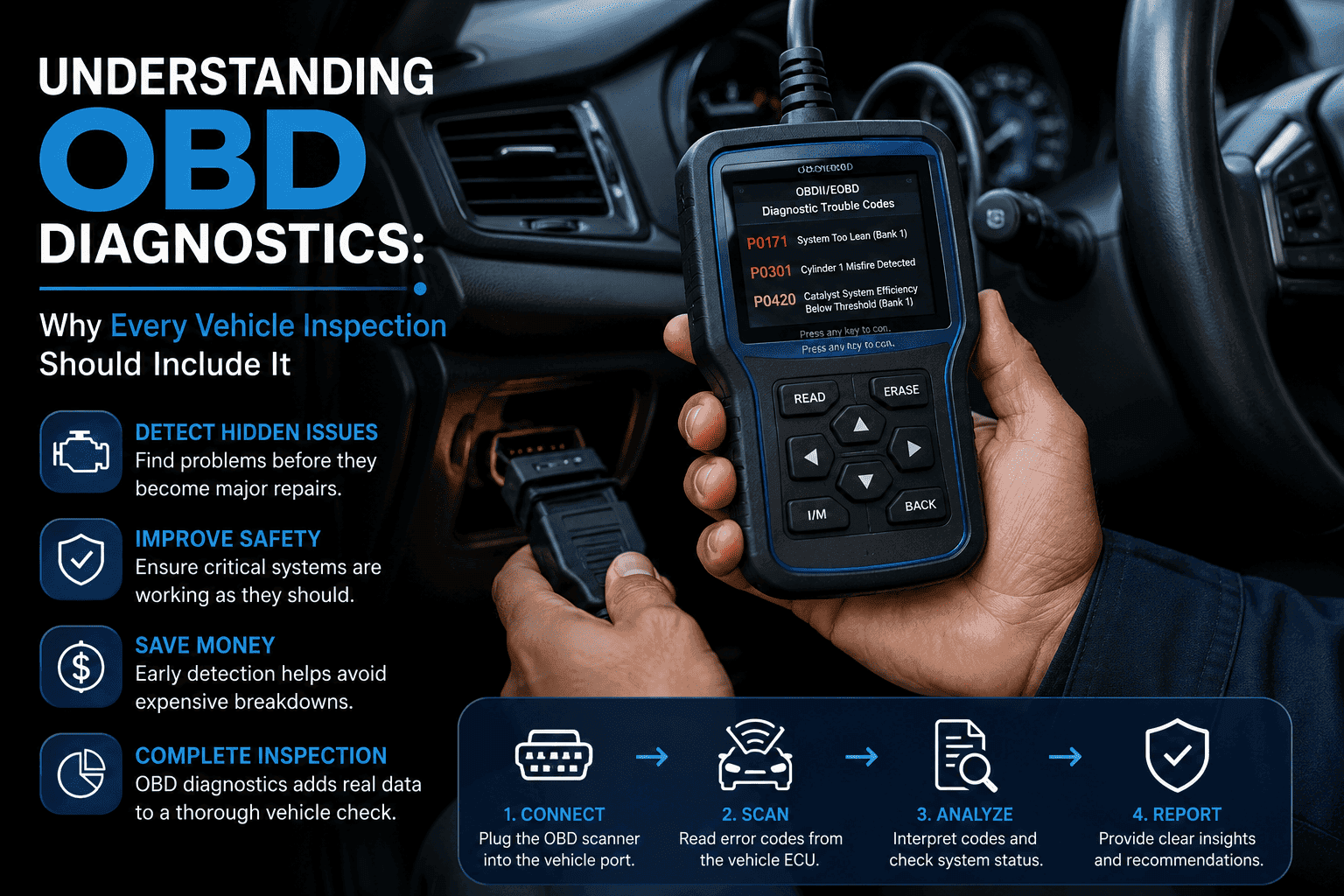
Understanding OBD Diagnostics: Why Every Vehicle Inspection Should Include It
Modern vehicles are equipped with dozens of electronic control units (ECUs) that constantly monitor engine performance, emissions, safety systems, and various electrical components. While many problems are visible during a physical inspection, several critical issues remain hidden unless the vehicle undergoes an On-Board Diagnostics (OBD) scan.
Whether you are buying a used car, inspecting a new vehicle, or troubleshooting a warning light, OBD diagnostics provide valuable information that cannot be identified through visual inspection alone.
What is OBD Diagnostics?
On-Board Diagnostics (OBD) is a standardized electronic system built into modern vehicles that continuously monitors the health of various components.
Whenever the system detects abnormal behaviour, it stores a Diagnostic Trouble Code (DTC) inside the vehicle's computer. These codes can be read using an OBD scanner connected to the diagnostic port, allowing technicians to identify faults quickly and accurately.
What Does an OBD Scan Check?
An OBD diagnostic scan communicates with multiple control modules in the vehicle, including:
Engine Control Module (ECM)
Transmission Control Module (TCM)
ABS Control Module
Airbag (SRS) System
Body Control Module
Emission Control System
Battery Management System (in applicable vehicles)
The scan provides detailed information about the health of these systems and identifies any stored fault codes.
Why Physical Inspection Alone Isn't Enough
A vehicle may appear to be in excellent condition externally while hiding electronic or sensor-related problems internally.
Examples include:
Intermittent engine faults
Sensor failures
Misfire history
Battery voltage abnormalities
Emission system issues
Transmission communication faults
Airbag warning history
Many of these problems may not produce obvious symptoms during a short test drive but can still be detected through OBD diagnostics.
Common Issues Identified Through OBD Diagnostics
A professional OBD scan can detect numerous issues, including:
Engine misfires
Oxygen sensor failures
Faulty ignition coils
Fuel system problems
Coolant temperature sensor faults
Mass Air Flow (MAF) sensor issues
Catalytic converter efficiency problems
Battery charging system faults
ABS sensor failures
Transmission errors
Early detection helps prevent expensive repairs in the future.
Importance During Used Car Inspection
When purchasing a used vehicle, an OBD scan is one of the most valuable diagnostic tools available.
It helps identify:
Hidden warning codes
Recently cleared fault codes
Pending faults that have not yet triggered the dashboard warning light
Engine performance abnormalities
Transmission issues
Emission-related defects
This information enables buyers to make informed decisions and negotiate repairs before completing the purchase.
Importance During New Car Delivery Inspection
Many buyers assume that a brand-new vehicle is free from defects. While new cars undergo factory quality checks, transportation, storage, and handling can occasionally introduce electronic issues.
An OBD scan during a Pre-Delivery Inspection helps verify that:
No fault codes are stored
All electronic systems communicate correctly
Battery health is satisfactory
No warning systems have been disabled or reset
This provides additional confidence before taking delivery.
Can OBD Clear Fault Codes?
Yes, most diagnostic tools can erase stored fault codes.
However, clearing codes without identifying and repairing the underlying issue is not a solution. If the fault still exists, the warning light will usually return after the vehicle completes its self-diagnostic cycle.
A professional inspection focuses on understanding the root cause rather than simply clearing codes.
Limitations of OBD Diagnostics
Although extremely useful, OBD diagnostics should not replace a comprehensive physical inspection.
Certain problems cannot be detected electronically, such as:
Paint repairs
Body panel misalignment
Rust
Suspension wear
Tyre condition
Fluid leaks
Interior damage
Accident repairs
The most effective vehicle inspection combines detailed physical checks with electronic diagnostics.
Why Professional OBD Equipment Matters
Basic consumer-grade scanners can read generic fault codes, but professional diagnostic tools offer significantly more information.
Advanced scanners can:
Access manufacturer-specific modules
Read live sensor data
Monitor battery performance
Perform system health checks
View freeze-frame data
Detect pending and historical fault codes
Professional equipment provides a much clearer understanding of the vehicle's condition.
Final Thoughts
As vehicles become increasingly dependent on electronics and software, OBD diagnostics have become an essential part of modern vehicle inspections. Whether you are purchasing a used car, accepting delivery of a new one, or investigating a dashboard warning light, an OBD scan provides insights that a visual inspection alone cannot.
Combining professional OBD diagnostics with a thorough physical inspection ensures that hidden faults are identified early, helping owners avoid unexpected repairs, improve safety, and make informed decisions about their vehicles.